

P
U
B
L
I
C
A
T
I
O
N
S
The YWHAG Foundation is proud to highlight a growing body of scientific research dedicated to understanding the YWHAG gene and its protein product, 14-3-3 γ. Over the past few years, new publications have shed light on the fundamental biology of 14-3-3γ, its role in brain development, neuronal signaling, and how mutations in this critical scaffolding protein leads to epilepsy, developmental delays, and other neurological symptoms. These studies span a range of discoveries from identifying how specific variants disrupt protein interactions and signaling pathways, to uncovering new regulatory mechanisms that impact 14-3-3γ’s stability and function.
Each new publication represents a step forward in unraveling the mechanisms behind YWHAG related disorders and brings the scientific community closer to potential therapeutic strategies. By compiling these research updates in one place, the Foundation aims to make cutting-edge discoveries more accessible to families, clinicians, and researchers, fostering collaboration and accelerating progress toward meaningful treatments.


YWHAG GENETIC
MUTATION RESEARCH

DECOUPLED CALCIUM HOMEOSTASIS AND SIGNALING ASSOCIATED WITH CYTOSKELETAL INSTABILITY IN YWHAG R132C INDUCED PLURIPOTENT STEM CELL-DERIVED CORTICAL NEURONS
First Published - 3 April 2026
YWHAG Syndrome (Developmental and Epileptic Encephalopathy 56, DEE56) is an ultra- rare childhood epilepsy associated with neurodevelopmental delays, with no therapeutic intervention available...

ROLE OF THE YWHAG GENE MUTATION IS DEVELOPMENTAL AND EPILEPTIC ENCEPHALOPATHY
First Published - 14 August 2025
Developmental and Epileptic Encephalopathy (DEE) is a severe neurological condition characterized by epileptic seizures and cognitive developmental impairments. Mutations in the YWHAG gene, which encodes the 14-3-3γ protein, are implicated in DEE...
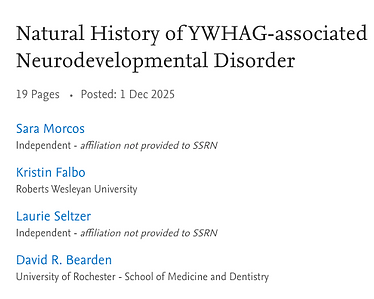
NATURAL HISTORY OF YWHAG-ASSOCIATED NEURODEVELOPMENTAL DISORDER
First Published - 1 Decemeber 2025
The YWHAG gene encodes a member of the 14-3-3 protein family important for cellular signaling and neuronal migration. Recent studies suggest its role in early-onset epilepsy, epileptic encephalopathy, and seizures in children....
MORE ARTICLES COMING SOON!
14-3-3 Y RESEARCH

ATP-DRIVEN ALLOSTERIC REGULATION OF 14-3-3: POSITIVE MODULATION OF ATP HYROLYSIS AND NEGATIVE REGULATION OF PEPTIDE BINDING
First Published - 12 September 2025
Many 14-3-3 paralogs, except sigma, could bind and hydrolyze ATP. However, the catalytic residues and the significance of ATP binding or hydrolysis remain unknown...
MORE ARTICLES COMING SOON!